
55: A Different Kind of Résumé
Oct 25, 2026How professional experience, inner work, and worldview inquiry can become one integrated path.
For much of my life, I experienced my development as three separate streams.
- There was my professional life: the international executive career, the responsibilities, the organisations, the leadership challenges, the big transformation programmes and later my work as an Executive Coach, Mentor, and Transformation Advisor.
- There was my personal development: the long and often uncomfortable work of facing fear, resentment, anger, self-rejection, and the emotional patterns shaped by my early life.
- And there was my deep curiosity about reality itself: what reality is, how we make sense of it, and why many of our dominant explanations seem unable to account for the full range of human experience.
For many years these streams ran in parallel. Today, I see the work differently.
As I approach my 55th birthday, this feels like the right moment to pause and take stock. Not in the form of a traditional résumé, and not as a polished life story, but as an honest status report:
- What has shaped me?
- What has endured?
- What is still unfinished?
- And what kind of work now wants to come through my life more clearly?
The task is not to choose between the different streams. The task is to integrate them.
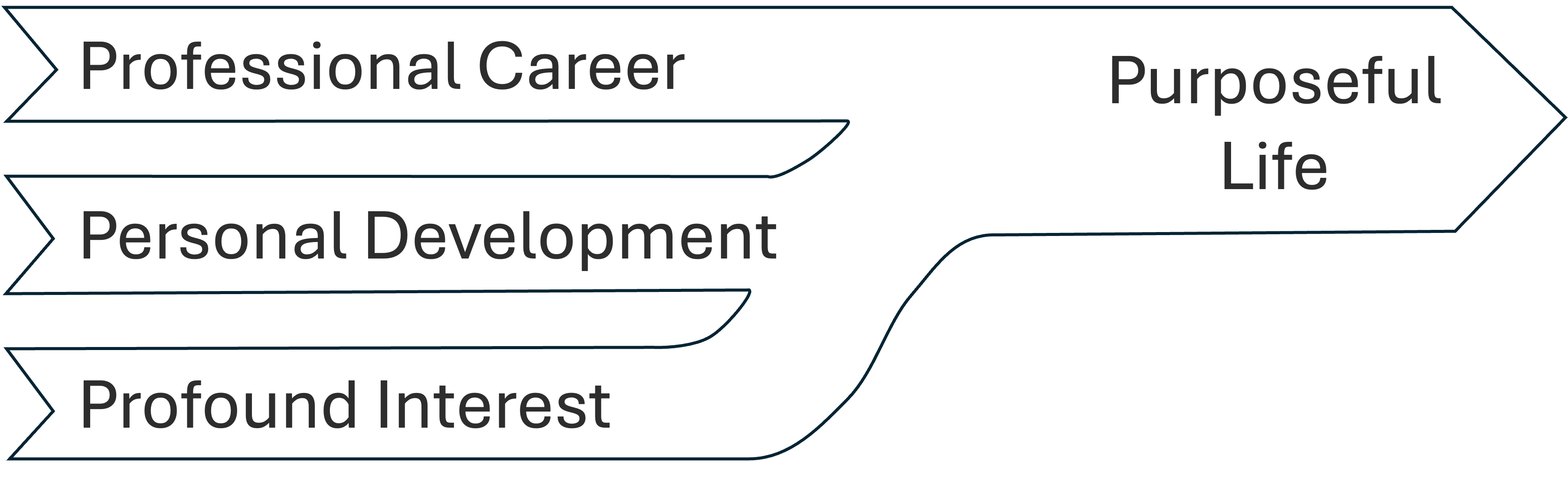
A purposeful life is not a life where everything is tidy, resolved, or easy to explain. It is a life where the different strands begin to serve one another.
- Professional experience becomes more than achievement.
- Personal development becomes more than private healing.
- Intellectual and spiritual inquiry becomes more than theory.
They become one path.
In that sense, this text is a different kind of résumé. Less a list of positions, titles, and achievements, and more a record of the capacities, questions, wounds, insights, and responsibilities that have shaped the work.
The professional stream
My professional career began in the corporate world and developed into senior executive responsibility. Until the end of 2012, I was employed in executive roles. During that time, I learned a great deal about leadership, organisations, pressure, performance, transformations, politics, decision-making, and the complexity of human systems.
In 2008, while still employed, I started my coaching practice part-time. On 1 January 2013, I moved into this work full-time.
Since then, my work has focused on senior leaders, leadership teams, and high potentials. I support people who carry responsibility, who influence systems, and who often have to navigate complexity without simple answers.
This work has shown me something again and again: leadership is never only about skill.
It is also about perception.
- How do we see ourselves?
- How do we interpret reality?
- How do we respond when our identity is challenged?
- How do we handle fear, uncertainty, disagreement, rejection, power, and responsibility?
The longer I have worked with leaders, the more I have seen that the outer work of leadership and the inner work of development cannot be separated. A leader’s worldview shapes what they notice, what they ignore, what they defend, and what they are able to transform.
The personal stream
The second stream is more private, but no less important.
I have been engaged in psychological and personal development work since I was 18. I am now 55. That means this has been a long path, not a short intervention.
Some of the work has been about fear of rejection. Some of it has been about self-rejection. Some of it has been about resentment, anger, and deeper core emotions that are not always easy to name.
My family background was challenging. Like many people, I did not leave childhood as a blank slate. I carried patterns, sensitivities, protections, wounds, and assumptions into adult life.
Over time, I have come to understand personal development less as a linear journey and more as peeling the layers of an onion.
You work on something sincerely. You gain insight. You make progress. You feel freer. Then, at another stage of life, a deeper layer appears.
This can be humbling.
It can also be frustrating. Part of me would have liked to say, “I have dealt with this now. It is finished.”
But human development does not seem to work that way.
The same themes can return at different levels. Fear of rejection may appear first in relationships, then in professional visibility, then in bringing a new body of work into the world. Anger may first appear as a reaction to others, then reveal itself as a protector of pain, then become a doorway into deeper honesty.
This is not failure. It is development.
The personal stream has taught me that transformation is not an abstract concept. It happens in the body, in relationships, in difficult conversations, in the willingness to feel what we have avoided, and in the discipline of not identifying completely with our defensive patterns.
The inquiry stream
The third stream has been my profound interest in the nature of reality.
For a long time, I have been curious about the assumptions underneath our normal way of seeing the world.
- What do we believe reality is made of?
- What do we consider possible?
- What do we dismiss too quickly?
- What do our models explain well, and what do they fail to explain?
The current mainstream worldview, which I often describe as the Red Worldview or Red concept of reality, has brought enormous progress. It is strongly linked to materialist, mechanistic, and reductionist assumptions. It has helped us build science, technology, industry, medicine, and much of the modern world.
I do not reject it. Quite the contrary. But I do experience it as insufficient.
It does not fully explain many phenomena, inconsistencies, and paradoxes that appear across science, human experience, consciousness, healing, intuition, and synchronicity. It often tries to reduce these experiences to error, illusion, coincidence, or pathology.
Sometimes that may be correct. But not always.
This is where an Extended Green Worldview, or Green concept of reality, becomes important to me.
In simple terms, I see the Green Worldview as Red plus an Information Field.
- In the Red Worldview, matter and energy are fundamental.
- In the Green Worldview, matter, energy, and information are fundamental.
This Information Field can be understood as universal consciousness, non-local consciousness, or a deeper field of intelligence in which individual consciousness participates. This idea also has parallels in many spiritual wisdom traditions, even if the language differs.
For me as a scientifically grounded mechanical engineer, this is not about abandoning rationality. It is about extending it. This is our epistemic responsibility.
It is about asking whether our current model of reality is broad enough to include what many people directly experience, what ancient traditions have explored for centuries, and what emerging fields of inquiry are beginning to reconsider.
At 55, I am less interested in separating these dimensions into clean categories. The professional, the personal, and the philosophical increasingly belong together. Each has changed the others. Each has made the work more demanding. And each has made it more honest.
Worldview Agility
This is where the three streams begin to meet.
Worldview Agility is the capacity to recognise, examine, and move between different concepts of reality without becoming rigidly attached to one of them.
It asks a simple but demanding question:
- What worldview am I using right now, and what does it make possible or impossible for me to see?
For leaders, this matters.
A worldview is not just a philosophy. It is an operating system. It shapes strategy, culture, ethics, innovation, conflict, decision-making, and transformation.
- If I believe reality is only material, I will lead in one way.
- If I believe consciousness, information, and interconnectedness are fundamental, I will lead differently.
- If I can understand both worldviews, I have more range.
This does not mean being vague or relativistic. It means becoming more precise about the assumptions beneath our thinking.
In leadership, many conflicts are not only disagreements about decisions. They are disagreements between worldviews. People may use the same words and live in different realities.
Worldview Agility helps make those realities visible.
The fear of bringing this work into the market
It would be dishonest to write about this without naming the fear.
Bringing Worldview Agility into the market touches my old fear of rejection.
Part of me knows this work matters. Another part anticipates being misunderstood, dismissed, labelled, or rejected. That fear is not theoretical. It connects directly to the personal stream of my life.
This is why the integration matters.
If I treat Worldview Agility only as an intellectual concept, I can stay protected. I can keep refining the model. I can explain more. I can wait until it is perfect.
But if I treat it as part of a purposeful life, I have to bring it forward while still being human.
- Not fully healed.
- Not beyond fear.
- Not immune to criticism.
- But responsible for what has become clear to me.
This is one of the deeper challenges of purpose. Purpose is not only found in what inspires us. It also asks us to meet the fears that stand between insight and expression.
Integration instead of separation
When I look back, I can see why the three streams had to remain separate for a while.
- The professional stream gave me real-world grounding. It taught me about responsibility, leadership, organisations, and the practical pressures people face.
- The personal stream taught me humility. It showed me that inner patterns shape outer behaviour, and that development requires courage, patience, and emotional honesty.
- The inquiry stream opened the larger frame. It challenged me to question inherited assumptions about reality, consciousness, and human potential.
Now the work is to bring them together.
- Professional life without inner work can become performance without depth.
- Inner work without a larger worldview can become self-improvement without context.
- Worldview inquiry without professional grounding can become abstraction without impact.
Integrated, they become something more useful.
They become a foundation for purposeful leadership, transformation, and contribution.
A purposeful life is not a finished life
I do not see purposeful life as a final destination.
It is not a state where all doubt disappears. It is not a personal brand. It is not a perfectly coherent story we tell about ourselves after the difficult parts are over.
- A purposeful life is an ongoing act of integration.
It asks:
- What has my professional life taught me?
- What has my suffering taught me?
- What has my curiosity revealed?
- What am I willing to stand for, even if it is not yet fully accepted?
- What wants to come through my life now?
For me, the answer is increasingly connected to Worldview Agility.
It brings together my executive experience, my decades of personal work, and my inquiry into reality and consciousness. It gives language to something I have been circling for a long time.
It also asks me to become more visible.
That is not easy.
But perhaps that is part of the point.
Purpose does not remove fear. It gives us a reason to work with fear differently.
Closing reflection
At 55, I do not feel that I am starting from scratch. I also do not feel that I have arrived. I feel that many strands are beginning to make sense together.
This is the status report I can offer: I am still integrating. I am still learning how to bring professional skill, personal development, and worldview inquiry into more coherent service.
The aim is not to become a finished version of myself. The aim is to keep becoming more useful, more awake, and more responsible in the work that remains.
The executive career, the coaching and mentoring, the psychological work, the family background, the fear of rejection, the inquiry into reality, the interest in consciousness, and the desire to support leaders in transformation are not separate chapters.
They are part of one movement.
A purposeful life may be exactly that: the moment when we stop trying to divide ourselves into acceptable parts and begin to serve from the whole of what life has shaped in us.
Not perfectly. But honestly.
And with enough courage to bring the work into the world.
(This article was inspired by an Intuitive Idea I had on 14th October 2026.)